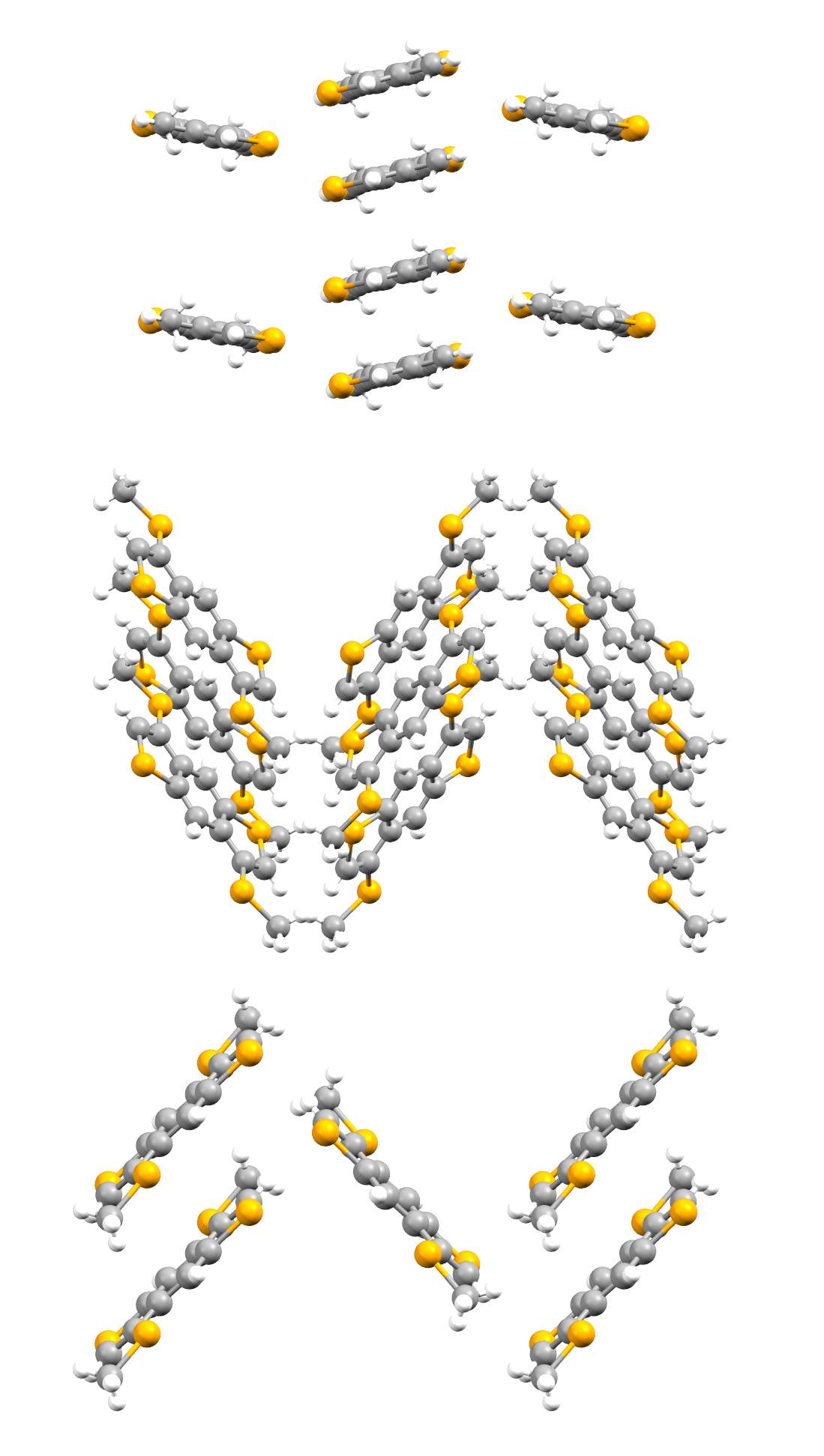

Reproduced from Graziosi, Patrizio, et al. "Electron-phonon coupling and mobility modeling in organic semiconductors: Method and application to two tetracene polymorphs." Physical Review Materials 9.2 (2025): 024603.
Charge Transport Simulation in Electronic Materials for Environment-friendly Applications
Contact: Patrizio Graziosi
We study the charge transport in materials with environment-oriented applications. We couple DFT electronic structure calculations with semiclassical Boltzmann transport to describe the full energy, band index, and momentum dependence of the carrier relaxation times. Our method considers all scattering mechanisms (acoustic, non polar optic and polar phonons, ionized impurities) independently, as well as intra- and inter- band transitions and provides predictive capabilities and accuracy. The developed simulator is vailable open-source at https://github.com/PatrizioGraziosi/ELECTRA. We also investigate computational recipes to parametrize the electron-phono coupling in a transport oriented fashion. At present, the materials we are studing can find application in thermoelecetricity or organic electronics.
The former takles one of the most important challenges of our society: energy sustainability and the impact of the use of fossil fuels on the environment. The majority of the world’s power originates from fossil fuels, but roughly one third of all this energy consumption ends up as low-grade waste heat, thus several TW of heat are lost to the environment. Solid state thermoelectric generators (TEG) convert heat flow into useful electrical power and could provide large energy savings. Thermoelectric (TE) materials are used to build thermoelectric generators (TEG), which are solid-state devices capable to convert heat flow into useful electrical power and could provide energy savings and reduced dependence on fossil fuels. Indeed, The TEG efficiency is linked to the ability of TE materials to convert heat into electricity, which depends on the TE transport coefficients. One of the main challenges of the TE research area and industry is the identification and design of optimal materials out of the myriad possibilities of alloys and new generation material combinations. Our research here is focused on the identification of which are the leading materials properties to be searched for achieving more efficient TE materials. Thus, we aim at delivering to the experimental community research directions and information to understand the results. We consider a detailed scattering physics, which is essential in capturing the correct transport features. About the latter, we concentrate on crystalline Organic Semiconductors (OSC), which have emerged as attractive candidates as active layers in several new electronic technologies: displays (OLED), unconventional flexible, stretchable and/or wearable devices, phototransistors, easy processable large area electronics, organic photovoltaics (OPV), energy storage (redox flow batteries, organic electrodes, pseudo-/super-capacitors, gas storage and separation), photocatalytic systems, sensing applications, and others. Moreover, OSC are based on abundant, eco-friendly, and cheap elements, nominally C, O, N, S, with negligible content of critical raw materials. This hallmark is crucial in the development of the next generation of sustainable functional materials. However, a worldwide use of OSC in electronics-related applications, is hampered by the lack of predictive understanding of the inter-relationship between solid-state packing and performance of the device (whatever type of device). Our research aims at bridging this gap. We start with the description of the electornic structure andits validation via the calculation of the spectroscopical properties (Raman and IR spectra). We then investigate the parametrization the electron-phonon coupling (EPC), which shapes the OSC transport characteristics. Finally, we focus on polymorphism, the impact on the mobility of the coexistence of different polymorphs inthe same specimen, and the possibility to describe quantitatively extended defects like dislpcations and grain boundaries.Selected Publications:
Graziosi, Patrizio, et al. "Electron-phonon coupling and mobility modeling in organic semiconductors: Method and application to two tetracene polymorphs." Physical Review Materials 9.2 (2025): 024603.
Graziosi, Patrizio, et al. "Materials design criteria for ultrahigh thermoelectric power factors in metals." PRX Energy 3.4 (2024): 043009.
Graziosi, Patrizio, Zhen Li, and Neophytos Neophytou. "ElecTra code: Full-band electronic transport properties of materials." Computer Physics Communications 287 (2023): 108670.